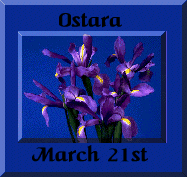
Ostara (Vernal Equinox, Alban Eiler)
March 21st
The first equinox of the year is the Vernal (or Spring) equinox. Astronomically the night and day are of the same length. Technically, it is the first day of spring.
The God is now in the youth of his life (approximately 8-16 years old). Since the day is no longer than the night, the God is still not at full power. After Ostara, the days grow progressively longer as the God grows.
Ostara is the pinnacle of the agricultural season. It is on this festival that spring has warmed the Earth enough for the first crops to be planted. The winter frost no longer threatens the tiny plants as they begin to grow with the ever increasing sunlight. Ostara is a festival most favored by children. The threshold time is dawn so many children flock to parks and outdoor settings to enjoy the first breath of spring. Ostara festivals should ideally be held outside. A picnic in a park is perfect. Families can come together and share dishes, dance, play springtime modern games such as badminton, football, or softball.
Favored among children is feeding the ducks. Egg hunts are also fun and symbolic. Eggs are a representation of the creation. The shell represents Earth, the membrane is Air, the yolk is Fire, and the white is Water. Eggs should be used somewhere in your day, whether you decorate them, eat them, or hunt them.
Traditionally, woman spent Ostara barefoot. This brought them closer to the Mother. Woman and girls pick wildflowers of spring and place them freely in their hair (Dandelion and Heather are usually the first flowers of the season and the most common).
The close of the day is given to a prayer of thanks to the God and Goddess for the renewed Earth and all the things that spring will bring. By dusk, all are exhausted and we find our way home to sleep. The festival usually ends when the sun goes down.
Ostera Incenses:
Lavender, narcissus, broom, orris, violet
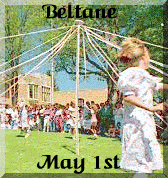
Beltane (May Day)
May 1st
Beltane is the third of the fire festivals and the fertility sabbat. The God is now in young adulthood (age 17-21) and ready to couple with the Goddess. He is feeling the natural drive of sexuality and has fallen deeply in love with the Goddess. In a field, the two have united sexually and the Goddess conceives. After which, the God and Goddess are joined in a wedding ceremony.
Beltane was the one festival that the medieval Christian sects feared the most. It represented human sexuality which the Church strived to repress. One can see from the chronology of events between the God and Goddess that they coupled first and married second. This was in direct conflict with the Christian way. Pagans did not believe that it was necessary to marry in order to express sexuality and the desire for children. It was for this reason that the Church strove to supress these rituals.
The beginning of a Pagan marriage usually began on Beltane. On this day, a couple agreed to live with one another for a year and a day. When that time was up, they could then choose to marry. This year and a day gave them time to get to know one another without the pressure of a formal bond. If the union was unsatisfying to both, they could part with no regrets or hassle. This idea, of course, was a sinful concept for the Church. To Pagans, any child born of the union before formal marriage was not considered a bastard. Any child born of an un-wed union retained his mother's name as a middle name and took the father's name as a surname. This way, the lineage of the parents was not lost.
Although Beltane was replaced with the modern festival May Day, many of the original representations can be seen in May Day practices. The most famous, being the maypole, was a representation of the phallus, the virile organ of the man. Flowers such as Damiana were used not only for decoration, but for their aphrodisiac qualities. Aphrodisiac herbs were used to season cakes and wines to promote the sexual urge.
Beltane is another outdoor festival. At dawn, the threshold time, picnics and outdoor sports are recommended. Lovemaking with your mate should take place on Beltane. Since it is a fertility rite, conception is the ultimate goal. If you do not want children (or have had enough) proper contraceptions should be used. Pagans do not discourage contraception. It is ultimately the couples choice on when and how many children are wanted.
Some people recommend lovemaking outside enveloped in Mother Nature, however, modern laws prohibit that activity. Lovemaking should take place within the confines of your home. If you have no access to an enclosed, private yard, a bright room wherein the sun shines, is acceptable. Make sure to open all of your windows to allow nature to filter in the room. In ancient times, the Great Rite (the symbolic unification of the God and the Goddess between a priest and priestess) was often performed. Due to modern diseases such as AIDS and STD's, the Great Rite is rarely performed by unless barrier contraception is used to prevent the exchange of bodily fluids. Recently, the Great Rite, if performed on Beltane, uses only mock motions and actual penetration is rarely done. Modern deadly sexually transmitted diseases have paved the way for monogamous relationships and Pagans usually respect the rights and wishes of couples, leaving the Great Rite to be performed between husbands and wives; mate and mates, not Priests and Priestesses, unless of course it is symbolic only.
Beltane Incenses:
Lilac, heather, damiana, orris root (powdered), rose, rosemary,
snapdragon, thistle
Back to Sabbat Index
Back Home
Yule and Imbolc
Ostara and Beltane
Midsummer an