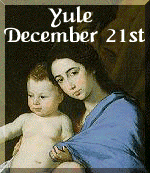
Yule (Winter Solstice, Midwinter, Alban Arthan)
December 21st
Since the Wiccan year begins November 1st as opposed to the legal date of January 1st, the first holiday of the season is Yule. Yule is the winter solstice wherein the night is the longest of the year. After the solstice, the nights grow shorter as the sun gains strength, bringing it closer to spring and summer.
Traditionally, Yule represents the drawing near to the end of the winter season. It is the preparation of the sun's rebirth in the spring and summer. During this time, the Goddess has given birth to her son, the new God. In the circle of life, Yule represents the reincarnation of the spirit into a newborn child. Whether celebrating Christmas or Yule, each holiday represents the birth of a child; life reborn in a season of cruel and deadly weather. It is a time to celebrate joyously.
Agriculturally speaking, Yule was the time to enjoy the fruits of labor accomplished in the previous harvest season. The grain and fruits that were gathered in the previous month have been brought out of storage and enjoyed during the harsh, dead growing season of December.
The threshold time of Yule is dawn. Dawn represents the new sun in the sky, as with the newborn child. All parties or celebrations should begin at that time. Modern traditions allows for an early breakfast or brunch with loved ones as a beautiful way to celebrate the day. As with any birthday, presents are exchanged, songs are sung, and general merrymaking is made.
My household celebrates Yule by harvesting a Christmas tree and decorating it with faeries, candles, sprigs of baby's breath, balls, and popcorn garland. We adorn the top with an angel (which can be interpreted as a faerie). We usually throw some sort of a party on Yule. We celebrate with a small brunch consisting of apples, pumpkin pie, white wine and white cakes. The brunch usually consists of only relatives. A larger party for our friends is then held in the evening.
If you are paired with a Christian mate, or choose to celebrate Christmas for family, have no fear that your traditions will be downplayed. Many of the current traditions of the Yule season are Pagan in origin so can be shared with both Christians and Pagans.
The Yule Log The yule log, when lit during the cold night, represents the ever present light of the sun, of the God. A piece of the log is often kept for the whole year in hopes that it will bring luck.
Mistletoe Mistletoe naturally grows on oak trees (the most sacred of all trees) by the Druids during the Yule season. If tribes were warring during the Yule season, they were forbidden to fight underneath the mistletoe, hence the tradition of kissing. The white juice from the mistletoe berry represented the male sperm.
Reindeer The reindeer (or stag) has always been a representation of the God in his animal form. The God has always had a closer relationship with animals than the Goddess and was often represented as a satyr (half man, half goat or stag).
Red and Green The traditional colors of the Christmas and Yule season are red and green. The green represented the coming of the spring season as well as the evergreen flora present and thriving throughout the winter. Red represents the virginity of the child God as well as the lochia (bloody discharge after the birth of a child) that is released.
Wreaths Wreaths (sprigs of evergreen trees formatted in a circle) represent the circle of life as it begins anew with the birth of the God.
Christmas Trees Evergreen trees were unearth in their entirety and brought into households to share warmth. The trees were decorated as a way of honoring them as guests. In the warm spring, the tree was replanted outside.
Yule Incenses:
Cedar, holly, mistletoe (poisonous), ivy, juniper, sandalwood, pine
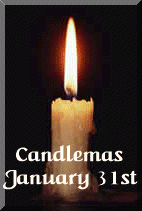
Imbolc (Candlemas, Disting, Brigid)
February 1st
Imbolc is the second fire festival of the new year. This means that it does not fall on and astrological occurrence but makes an important change in the seasons. Imbolc represents the official end of the winter season.
At Imbolc, the Goddess is recovering from childbirth. The sun, which shines longer each day, revitalizes her energy. The God is in the early youth (2-7 years old) of his life. He is discovering the world around him and growing stronger as the sun does.
Preparations are now being made to begin the new harvest year as the days grow longer. Imbolc is the banishment of winter and the harsh conditions it brings. The Earth is nourished each day by the sun and prepares to grow.
Imbolc is also a time to seek out and celebrate the illuminations in one's life. Aside from Beltane, Imbolc is a beautiful time to seal a marriage. On this day, one celebrates one's blessings of love, life, friendship, children, and good fortune.
At midnight on January 31st, my household lights the first of many candles. It is customary to light one candle in each room (or each corner of your home) to banish darkness. Although you needn't keep all the candles burning, one should remain lit until dawn. If you choose to keep one candle lit, do so under strict supervision. If you cannot attend to your candle all night, be sure to immerse it in water up to the top. A full sink or tub is ideal for that situation. Make sure nothing hangs over the flame such as a shower curtain or a sink awning. Lock any animals out of the rooms so they are not tempted to fool with the candle and knock it over. As one final safety measure, if you must leave your candle unattended, make sure the room in which it resides has a fire and smoke detector.
DISCLAIMER- I do not recommend leaving any candle unattended. The God and Goddess won't be offended if you snuff the candle out to preserve your life and that of your family.
After the initial candles are lit, one designated person lights a smaller personal candle off the Sabbat candle (the one that stays lit). The flame is then passed on to each person's candle. When all the personal candles are lit, we lead a group dedication of the Earth, the God, and the Goddess. A chalice is then passed around to each guest. Each guest sips the wine and makes a toast to the illumination in their lives. When the final toast is made, the remainder of the wine is either poured out onto the Earth or left outside as an offering. The remainder of the evening is spent making merry, feasting, and enjoying each other's company.
Imbolc Incenses:
Seaweed, rowan, mace, snowdrop
Back to Sabbat Index
Back Home
Yule and Imbolc
Ostara and Beltane
Midsummer and Lughnassad
Mabon and Samhain